
Good Practice
The Care Sector: A Case Study
As social care faces unprecedented regulatory shifts and evolving visa policies, staying informed is essential. Explore critical insights, regional updates, and practical resources to help your organization successfully navigate these changes.

Key Timeline of policy change
Care Workers were added to the Skilled Worker route in February 2022, having earlier been excluded from the August 2020 introduction of the Health & Care Visa. Following the end of free movement from the EU in January 2021, care workers who could previously come and go with ease, and without additional paperwork and costs, would need to go through the visa application process.
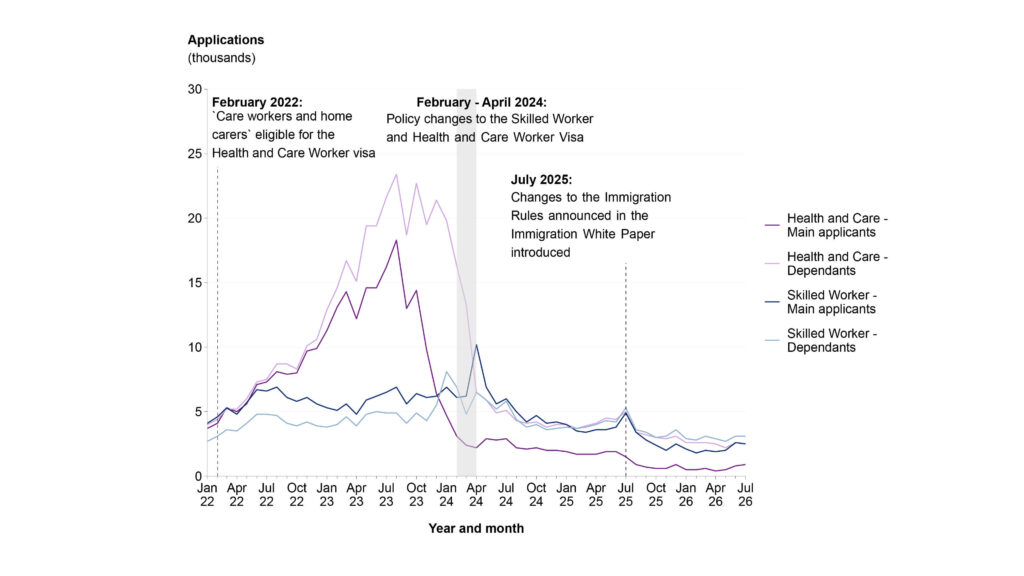
Between January 2022 and July 2026, a total of 291,600 workers (and 466,400 dependents) applied for the health and care worker visa. It’s worth noting that this is not limited to care workers, but includes nurses, doctors, and other health professionals as well. It also does not differentiate between those workers applying from overseas and those seeking to renew their visa while already in-country. As such, both workers and dependents are being double-counted, and non-care staff are also included in this figure.
What is the International Recruitment Fund?
The DHSC’s (Department for Health and Social Care) International Recruitment Fund was started in 2023/4, as a mechanism to support Providers to access international recruitment, to raise awareness of the issues involved, and encourage best practice and compliance. By the time this programme had been established and was running, the peak of new arrivals had passed and the priorities had shifted to a role of supporting those workers who have been ‘displaced’ by their employers being unable to continue their sponsorship. This programme will come to an end in March 2027, though the underlying issues will remain for some time into the future.
Based on concerns over the system generating cases of abuse and exploitation for migrant care workers in March 2022 there has been a tightening of visa conditions, as well as an increase in immigration enforcement operations. In March 2024 the government decided to restrict new arrivals from bringing dependants with them, including workers already in the UK transferring onto visa who may already have their family with them. A month later, in April 2024, the Shortage Occupation List was replaced by the Immigration Salary List, and the minimum salary requirements were raised (and have been raised almost every year since).
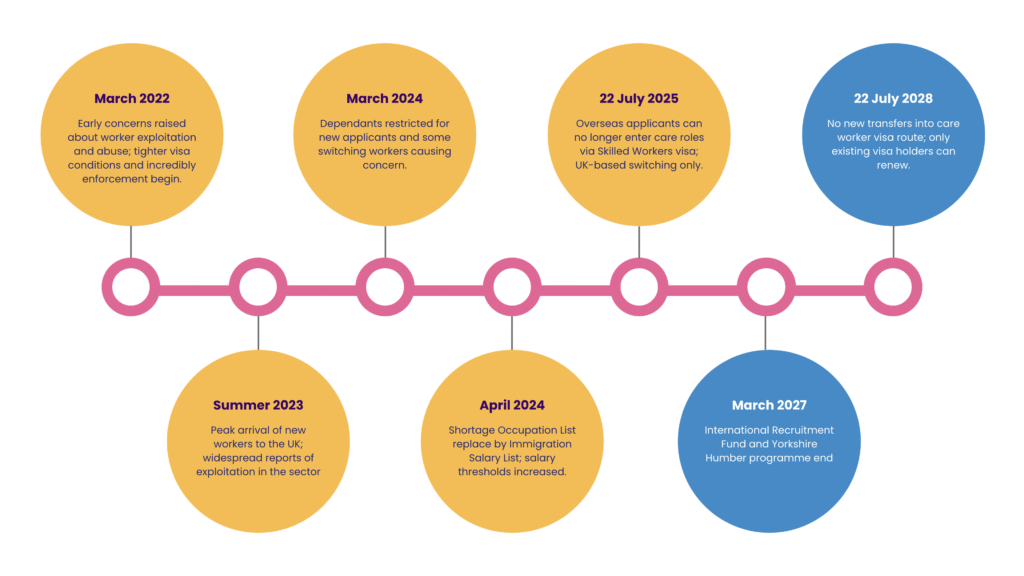
On July 22nd 2025, changes meant that no new applicants from outside the UK could access the Skilled Worker visa to work in care (care workers (SOC 6135) and senior care workers (SOC 6136)). Only people already in the UK could get work in this sector, either having a previous visa in the same role, or they could transition to this visa from another (ie, student/graduate, dependent, or other). To do this, people looking to change on to the Care Worker visa would need to work for an employer for three months (while still having right to work from their current visa) before they can apply for a visa.

Download the Health and Social Care Policy Timeline a PDF
From 22nd of July 2028, it will no longer be possible to transfer onto the care worker visa, from inside or outside of the country. What this means is that renewals and new visas will still be possible for those workers who are already on a Skilled Worker visa in care roles (ie, care workers (SOC 6135) and senior care workers (SOC 6136)), but no new staff will be able to join the visa. Students working part time in care, then taking a job in care after graduation (instead of in their own fields) will likely not be able to do so any longer.
The Future of the International Recruitment Fund programme in Y&H
At the end of March 2027, the national International Recruitment Fund will come to an end, and the regional Yorkshire Humber International Recruitment Fund programme with it. While their website will remain active for a period following this closure, offering guidance and information to both employers and workers, the infrastructure behind it, the Displaced Worker Scheme, and the central hub of support and resources will come to an end. Conversations are ongoing at both national and regional levels as to what, if anything, comes after this.
Alternative employment services and resources for care providers
While there will be no further employment matching delivered at scale locally, some commercial services such as lifted-talent.com and sponsorswitch.co.uk exist, though at a cost. Similarly, employers are likely to be inundated with direct applications, though these will not benefit from the screening or matching currently available.
For other guidance and support, the Yorkshire and the Humber Care Association Alliance has branches across most of the region and will continue to support Care Providers in numerous ways. Similarly, the Skills for Care Local networks for managers also offer a community of practice for Care Providers, and many local authorities also run a Provider Forum locally. For a more sponsorship-focused network, Migration Yorkshire also now runs a Regional Migrant Care Worker Forum bringing together key partners in the public, private, and third sectors to discuss issues and collaborate on solutions.
As for other coming changes, the national Earned Settlement model is being reformed and is likely to have critical effects on the migrant care sector workforce-especially those with temporary leave to remain and their employers. While no final decision has been made and however the changes will be finalised, they will have a considerable impact on both the workers and the sector more broadly, with a consultation that ended in February 2026, though no final decision on this has yet been made. Similarly, there is an ongoing question about the future of the Care Sector and its workforce. As such, and until more details emerge, speculation may be less helpful than their intention. Whatever changes are finalised with this, it will no doubt have considerable impact. In such variable times, remaining informed, connected, and aware is how we survive and thrive.
Useful Resources
Networks
Yorkshire and the Humber Care Association Alliance
Provider Zone | Bradford Connect to Support
Calderdale Adult Care Provider Forum at Orange Box
Leeds Providers Forum: Small Home Care Providers Together
Care Connected – North Yorkshire Partnerships
Networking opportunities for care providers – City of York Council
Toolkits
International recruitment toolkit – March 2024
Pastoral Care Guide for International Recruitment in Social Care – National Care Forum
International Recruitment – National Care Forum
Local Government Association (now limited access, but useful resource if subscriber)
Induction (Skills for Care, Induction packages and resources)
Induction toolkit (Skills for Care)
The Training Hub by Skills for Care
Different ways to develop your staff (Skills for Care)
Workers Support
Yhir directory (searchable database of support services by type and location)
Directory: safeguarding and wellbeing services | WMADASS
Migrant Action (drop-in sessions across SY and wider)
Support Services — Human Trafficking Foundation
Useful Resources :: South Yorkshire I.C.S. (for international workers in SY)